Usage, Real-World Fit, and Feature Comparison
In the last few years, PostgreSQL has moved from being “just another open-source database” to a serious enterprise-grade option. Many teams that traditionally depended on Oracle are now evaluating PostgreSQL for new projects, and in some cases, even migrating existing systems.
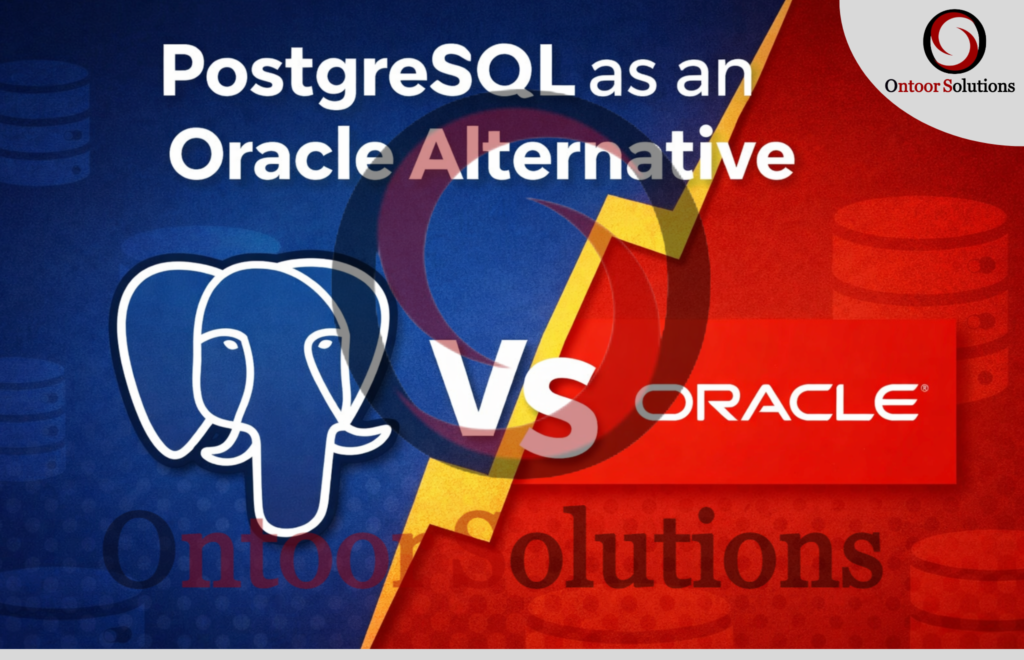
This shift is not driven by hype. It is driven by cost, flexibility, and how modern applications are being built today.
Let’s break this down clearly.
Where PostgreSQL is Commonly Used
PostgreSQL fits naturally into modern application architectures.
You will often see it used in:
- Web and SaaS applications
- Microservices and API-based systems
- Reporting and analytics platforms
- Applications with heavy JSON or semi-structured data
- Startups and enterprises looking to reduce database licensing cost
It is not uncommon today to see PostgreSQL backing systems with millions of users and terabytes of data.
Why PostgreSQL is Considered an Oracle Substitute
PostgreSQL is not a “lightweight” database. Architecturally and functionally, it covers a large part of what Oracle offers.
Key reasons teams consider PostgreSQL as an alternative:
- No licensing cost
- Strong SQL compliance
- Advanced indexing and query optimisation
- Transaction reliability and data consistency
- Support for stored procedures, triggers, and complex logic
- Mature ecosystem and long-term stability
For many business applications, PostgreSQL provides everything required without vendor lock-in.
Feature Comparison: Oracle vs PostgreSQL
Core Architecture
| Feature | Oracle | PostgreSQL |
|---|---|---|
| Server Model | Instance + Database | Server + Cluster |
| Multi-Database Support | One database per instance | Multiple databases per cluster |
| Schema Concept | Yes | Yes |
| Tablespaces | Yes | Yes |
From a logical design perspective, PostgreSQL feels familiar to anyone with Oracle experience.
SQL and Data Handling
| Area | Oracle | PostgreSQL |
|---|---|---|
| SQL Standard Support | Very High | Very High |
| Joins, Subqueries | Yes | Yes |
| CTEs (WITH clause) | Yes | Yes |
| Analytical Functions | Yes | Yes |
| JSON Support | Strong (12c+), Native JSON (21c+) | Excellent (JSONB) |
PostgreSQL’s JSONB support is one area where it clearly leads for modern applications.
PL/SQL vs PL/pgSQL
| Aspect | Oracle | PostgreSQL |
|---|---|---|
| Language | PL/SQL | PL/pgSQL |
| Procedures | Yes | Yes |
| Functions | Yes | Yes |
| Triggers | Yes | Yes |
| Packages | Yes | No (use schemas + functions) |
While PostgreSQL does not have packages exactly like Oracle, schemas combined with functions cover most real-world use cases.
Transactions and Reliability
Both databases are strong here.
- ACID compliant
- Strong transaction isolation
- Crash recovery support
- Write-Ahead Logging (WAL)
PostgreSQL WAL works conceptually like Oracle redo logs.
Indexing and Performance
| Index Type | Oracle | PostgreSQL |
|---|---|---|
| B-Tree | Yes | Yes |
| Bitmap | Yes (native) | No (bitmap scans only) |
| Function-based Index | Yes | Yes |
| Full Text Search | Yes (Oracle Text) | Built-in |
| JSON Indexing | Strong (JSON search, path indexes) | GIN / GiST |
For read-heavy and JSON-based workloads, PostgreSQL often performs extremely well.
Security and Access Control
Both support:
- Role-based access control
- Object-level privileges
- SSL connections
- Auditing options
Oracle has more built-in enterprise auditing tools, but PostgreSQL integrates well with external security and monitoring tools.
Cost and Licensing Reality
This is often the deciding factor.
| Area | Oracle | PostgreSQL |
|---|---|---|
| License Cost | High (Enterprise editions) | Free (open-source) |
| Vendor Lock-in | Yes (proprietary ecosystem) | No |
| Support | Paid (official) | Optional (community + vendors) |
For startups and mid-size companies, PostgreSQL removes a huge financial barrier without sacrificing capability.
When Oracle Still Makes Sense
Oracle is still a strong choice when:
- You rely heavily on Oracle-specific features
- You use RAC extensively
- Your system depends on tightly coupled Oracle tools
- Compliance or policy mandates Oracle usage
PostgreSQL is not about replacing Oracle everywhere. It is about choosing the right tool for the job.
When PostgreSQL Is the Smarter Choice
PostgreSQL shines when:
- Building new applications
- Migrating cost-sensitive systems
- Working with APIs and microservices
- Handling semi-structured data
- Avoiding long-term license commitments
For many teams, PostgreSQL becomes the default database, and Oracle is reserved for legacy or specialised systems.
Final Thoughts
PostgreSQL has reached a point where it is no longer “Oracle lite”.
It is a serious enterprise database with a different philosophy: open, flexible, and cost-effective.
If you design your application cleanly and avoid vendor-specific lock-in, PostgreSQL can handle most workloads that traditionally belonged to Oracle.
For new projects, the question is no longer:
“Is PostgreSQL good enough?”
It is often:
“Do we really need Oracle for this use case?”